
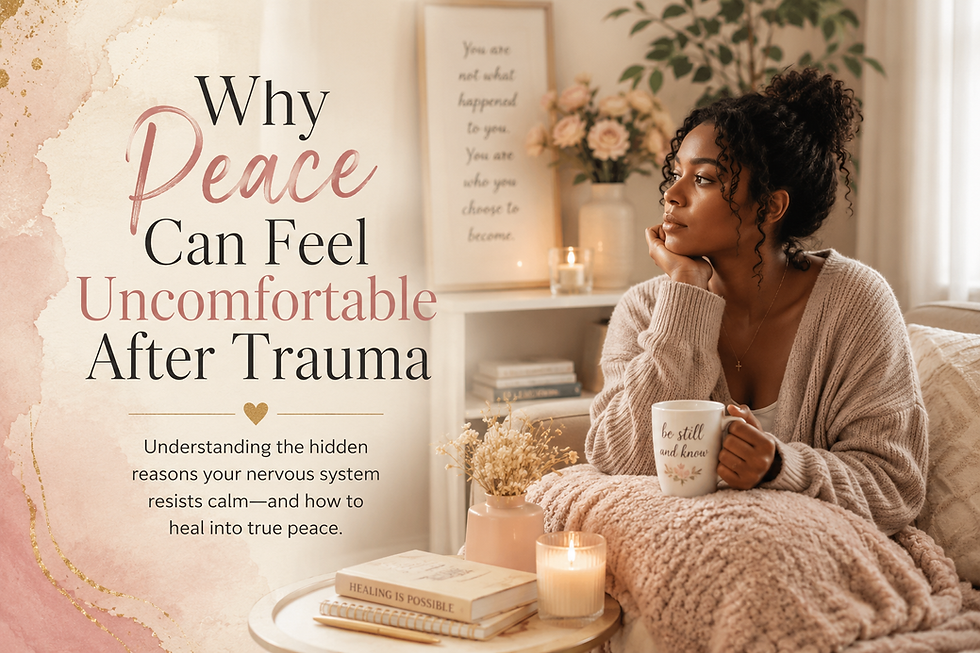
Why Peace Can Feel Uncomfortable After Trauma
Introduction
Have you ever noticed how a quiet moment can suddenly feel... unsafe?
You finally have an evening with nothing on fire. No arguments to referee, no crisis to manage, no one demanding something from you. And instead of relaxing, your chest tightens. Your mind starts scanning for what's about to go wrong. You catch yourself thinking, this is too good to last.. or worse, you manufacture a little chaos of your own, just to feel like yourself again.
If that sounds familiar, you're not broken, and you're not ungrateful for the calm. You're a person whose nervous system learned, a long time ago, that peace was often the quiet before another storm. For many of us who grew up in unpredictable homes, walked through painful relationships, or carried unspoken grief for years, chaos became familiar.. and familiar started to feel safer than peaceful, even when peaceful was what we prayed for.
This is one of the most under-talked-about parts of healing: peace itself can feel like a threat when your body was trained for survival. Understanding why is the first step toward finally being able to receive the peace God has been offering you all along.

A Relatable Scene
Picture Maya. She spent most of her twenties in relationships that kept her guessing.. texts that went silent for days, apologies that never quite added up, a constant low hum of "what did I do wrong?" She prayed for years for a peaceful life. A peaceful marriage. A peaceful mind.
Then she met David.
David is steady. He calls when he says he will. He doesn't raise his voice. There's no mystery to decode, no emotional puzzle to solve. And Maya, three months into dating him, finds herself... restless. Almost suspicious. She's caught herself picking small fights, testing whether he'll leave, half-waiting for the "real him" to show up.
She's not sabotaging her blessing because she doesn't want it. She's sabotaging it because her nervous system doesn't yet recognize peace as something you're allowed to keep.
Maya's story isn't rare. It's one of the quiet reasons so many people who long for peace end up feeling more comfortable managing chaos than receiving rest.

Why Peace Can Feel So Uncomfortable
1. Your Body Learned to Associate Calm With Danger
When you've lived through trauma.. whether it was a chaotic childhood, an unpredictable relationship, or a season of ongoing crisis.. your nervous system adapts to survive it. Hypervigilance becomes a form of protection. Constantly scanning for threats, bracing for impact, staying "on".. these aren't character flaws. They're adaptations that once kept you safe.
The trouble is, your body doesn't automatically know when the danger has passed. So when real peace shows up, it can register the same way an unfamiliar silence does in the wild.. not as safety, but as something's about to happen.

2. Chaos Gave You an Identity, Even If It Hurt
This one is harder to admit, but it's often true: chaos can become part of how we understand ourselves. The strong one. The fixer. The one who survives anything. When the chaos settles, that identity can feel like it's dissolving too.. and underneath it, we're left wondering who we are without a crisis to manage.
Peace doesn't just change your circumstances. It asks you to meet yourself without the armor.
3. Stillness Leaves Room for Feelings You've Been Outrunning
Chaos is loud. It keeps your hands busy and your mind occupied. Peace, by contrast, is quiet.. and quiet has a way of surfacing everything you didn't have time to feel while you were surviving. Grief you postponed. Anger you swallowed. Sadness you never had a safe moment to sit with.
It's not that peace creates pain. It's that peace finally gives pain room to be acknowledged.
4. You've Learned Not to Trust Good Things
If good seasons in your past were often followed by disappointment or loss, your mind may have quietly rewritten the rules: don't get too comfortable. This isn't pessimism.. it's a protective belief formed from real experience. But left unexamined, it can keep you bracing against blessings instead of receiving them.

A Biblical Perspective on Peace
Scripture doesn't describe peace as the absence of struggle.. it describes peace as a Person we're invited to know, and a presence that can hold steady even inside the struggle.
Philippians 4:6-7 doesn't say "wait until the chaos clears, and then you'll find peace." It says the peace of God, which transcends all understanding, will guard your heart and mind in the midst of your requests, your anxieties, your real life. That peace isn't a reward for having it all together. It's a gift for the moments you don't.
Consider also John 14:27, where Jesus makes an important distinction: "Peace I leave with you; my peace I give you. I do not give to you as the world gives." The peace the world offers is usually circumstantial.. it shows up when things are going well and vanishes the moment they don't. But the peace Jesus offers isn't dependent on your circumstances being calm. It's a peace that can coexist with uncertainty, because it isn't rooted in your ability to control outcomes.. it's rooted in His presence.
This matters deeply for anyone healing from trauma. You don't have to fully trust peace yet for it to be real. You don't have to feel safe overnight for God's peace to be present. Healing is often the slow process of letting your felt sense of safety catch up to the actual safety He's already offering.
Psalm 23 offers a beautiful picture of this: even "in the presence of my enemies," a table is prepared, and the cup is described as overflowing. Peace, in this Psalm, isn't the absence of threat.. it's the presence of God even when the threat is real. That's good news for anyone whose life hasn't been threat-free. Peace was never meant to require a perfect, danger-free world. It was meant to be found in Him, regardless of the world around you.

Practical Action Steps for Receiving Peace
Healing your relationship with peace isn't about forcing yourself to relax. It's about gently teaching your body and mind that calm is safe now. Here's where to start:
1. Name it when it happens.
The next time you feel unsettled by a peaceful moment, pause and say.. out loud or in a journal.. "This is unfamiliar, not unsafe." Naming the pattern interrupts the automatic response and gives you a moment to choose differently.
2. Practice staying five extra minutes.
When you notice the urge to create chaos, check your phone anxiously, pick a fight, or fill the silence.. try staying in the discomfort for five more minutes before reacting. You're not suppressing the urge; you're widening your capacity to tolerate peace.
3. Build a "safety anchor."
Choose a simple, physical reminder.. a verse on a sticky note, a hand over your heart, a specific breath prayer like "You are near, I am safe." Use it in moments when peace feels foreign. Over time, this becomes a bridge between what's true and what you feel.
4. Let yourself grieve the chaos, too.
It may sound strange, but if chaos gave you identity or purpose for years, it's okay to acknowledge the loss of that role as you release it. Grieving it isn't a step backward.. it's part of letting go with honesty instead of pressure.
5. Talk to someone who understands trauma.
A trauma-informed Christian counselor can help you work through the nervous system side of this, not just the spiritual side. Healing usually involves both.. renewing your mind and regulating your body.
6. Return to Scripture as an anchor, not an escape.
Rather than using verses to bypass the discomfort ("I just need to have more faith"), let Scripture meet you in it. Read Psalm 23 slowly. Sit with John 14:27. Let the words become familiar enough that they start to feel like home.

Reflection Questions
Take a few quiet minutes with these.. a journal can help you notice patterns you might otherwise miss.
When peace or calm shows up in my life, what's my first instinct.. to relax, or to brace?
Is there a role chaos has played in my identity that I haven't fully acknowledged?
What feelings tend to surface when things finally get quiet?
What would it look like to let peace stay, even before it feels fully familiar?
• Where in my life is God offering peace that I've been hesitant to receive?

A Prayer for Receiving Peace
Father,
Thank You that Your peace isn't dependent on my circumstances being perfect, and it isn't something I have to earn by having it all together. Thank You that You offer peace even in the presence of what unsettles me.
I confess that peace sometimes feels unfamiliar.. even uncomfortable.. because of what I've survived. Teach my heart and mind to recognize Your peace as safety, not as a warning sign. Where I've learned to brace for the next storm, help me learn to rest in Your presence instead.
Heal the parts of me that don't yet trust good things. Meet me in the quiet moments and remind me that You are near. Give me the courage to stay in peace even when it feels unfamiliar, and the patience to let my heart catch up to what You've already made true.
In Jesus' name, Amen.

Key Takeaways
Feeling uneasy during peaceful moments is a common trauma response, not a personal failure.
Your nervous system may associate chaos with familiarity and peace with unpredictability.. but this can be gently retrained.
Biblical peace isn't the absence of hardship; it's the presence of God within it.
Practical, small steps.. naming the discomfort, staying in it a little longer, anchoring yourself in Scripture.. help peace start to feel like home.
• Healing is a process of letting your felt sense of safety catch up to the truth of God's presence.
Call-to-Action
If this resonated with you, know that you're not alone - and you don't have to navigate this journey by yourself.
Continue the conversation by reading this week's Purpose Unleashed Story Series episode, She Was the Peaceful Woman He Prayed For... But He Wasn't Ready for Peace, where you'll see these struggles and breakthroughs unfold through a powerful, relatable story.
Then visit the Purpose Unleashed YouTube channel and watch this week's Wisdom Wednesday episode, Why Peace Feels Boring After a Lifetime of Chaos, where we explore why healing often feels unfamiliar and how God gently teaches us to embrace lasting peace.
If you're ready to go deeper, my book Love With a Crown will help you discover what it means to build relationships rooted in biblical wisdom, healthy love, and self-respect rather than striving or self-abandonment.
To put these lessons into practice each day, the Structured Woman Journal offers guided reflections, journaling prompts, and intentional exercises designed to help you cultivate peace, emotional maturity, and a life centred on faith.
Remember, peace isn't something you have to earn or force. It's something you learn to receive as you walk with God - one faithful step, one quiet moment, and one intentional day at a time.
I'd love for you to join our growing Purpose Unleashed community by subscribing to our YouTube channel, where every week we share Stories That Reveal Timeless Truth and Wisdom Wednesdays to encourage you to live with faith, wisdom, peace, and purpose.


![[Original size] Kp Logo3_edited.jpg](https://static.wixstatic.com/media/bb67dc_72a3317abedb495b81501749f401fed9~mv2.jpg/v1/crop/x_0,y_26,w_1500,h_1449/fill/w_205,h_198,al_c,q_80,usm_0.66_1.00_0.01,enc_avif,quality_auto/%5BOriginal%20size%5D%20Kp%20Logo3_edited.jpg)


Comments